Skip to Content
Exit

Universal Marking Inc

Author Archives: Universal Marking Inc

  1. CNC Engraving Medical Device Applications

    Comments Off on CNC Engraving Medical Device Applications

    Computer numerical control (CNC) engraving has become an indispensable tool in manufacturing, especially in medical device production. The precision and accuracy of this technology make it ideal for creating complex medical device components with intricate designs and patterns. In addition, it provides an economical solution for manufacturers when it comes to marking their products. It is crucial for medical devices to have permanent, legible, and accurate markings that meet strict government guidelines for Unique Device Identification (UDI). These labels must be on all devices, including medical implants, tools, and instruments, to ensure product identification and traceability. Below are examples of the typical applications of CNC engraving technology in the medical device manufacturing industry:

    1. Catheters and Medical Tubing

    Medical tubing and catheters are essential elements of various medical devices, such as respiratory, cardiovascular, and urological devices. CNC engraving is useful for marking these medical tools with specific information, such as manufacturer details, size, and batch numbers. Additionally, this technology can create patterns or textures on surfaces to enhance their functional properties.

    2. Dental Implants and Instruments

    CNC engraving is used in the dental industry to create high-quality dental implants and instruments, such as drills and scalers. For example, this technology can generate custom abutments to accurately fit the patient’s anatomy. In addition, it can be used to create intricate patterns on dental burs and drills, allowing for more efficient cutting during dental procedures.

    3. Diagnostic Equipment

    Automated engraving is widely used in manufacturing diagnostic equipment, including ultrasound probes and MRI coils. Precisely engineering intricate shapes and patterns ensures that the devices accurately generate and capture high-quality images. Moreover, it can be used to create channels or grooves on the surface of diagnostic equipment to facilitate the flow of fluids.

    4. Endoscopic Instruments

    Endoscopic instruments — including biopsy forceps and graspers — are used in various medical procedures, such as colonoscopies and gastroscopies. Engraving can create textured grips or patterns on the instruments’ surfaces, improving functionality. In addition, it can construct serrated edges on biopsy forceps or grooves on graspers, which enhance their grip and allow for greater maneuverability.

    5. Implantable Medical Devices

    Creating electrode contacts on pacemakers and defibrillators is one of the implantable medical devices’ most crucial engraving applications. These contacts must be precisely engineered to ensure proper communication between the device and the heart. Moreover, the process enables the creation of intricate patterns and shapes on the contact surface. This allows for optimal signal transmission and accurate stimulation of the heart.

    6. Neurosurgical Instruments

    Engraving allows for the creation of intricate patterns on the surface of neurosurgical instruments, such as the tips of cranial drills or the blades of retractors. The designs on these instruments are crucial for their proper function during surgical procedures. This is because they enable precise manipulation and control of tissues and structures in the brain and spinal cord.

    7. Orthopedic Implants

    CNC engraving is often used to produce orthopedic implants, such as knee and hip replacements. These implants are crucial in restoring mobility and enhancing the well-being of patients experiencing joint issues. Moreover, the precise engineering of orthopedic implants is critical to ensure they fit accurately, remain stable, and provide long-lasting performance. Therefore, automated engraving is required for these devices to function effectively.

    Partner With Universal Marking Inc. for All Your Part Marking Needs

    At Universal Marking Inc., we provide a comprehensive range of over 30 part marking services, making us your ultimate destination for your marking requirements! Our cutting-edge technology enables us to deliver top-notch services that meet the highest quality standards. We also cater to the needs of multiple sectors, including utility, aerospace, automotive, medical, retail, and steel fabrication. Get in touch with us today to explore our services further. You can also request a quote, and we will promptly respond to your inquiry!

  2. Uses of Metal Tags by the Utility Industry

    Comments Off on Uses of Metal Tags by the Utility Industry

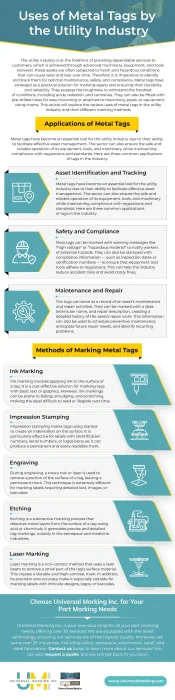
    The utility industry is at the forefront of providing dependable services to customers, which is achieved through advanced machinery, equipment, and tools. However, these assets are often subjected to harsh and hazardous conditions that can cause wear and tear over time. Therefore, it is imperative to identify and track them for optimal maintenance, safety, and compliance. Metal tags have emerged as a practical solution for marking assets and ensuring their durability and reliability. They possess the toughness to withstand the harshest of conditions, including acids, radiation, and corrosives. They can also be fitted with pre-drilled holes for easy mounting or attached to machinery, pipes, or equipment using chains. This article will explore the various uses of metal tags in the utility industry and their different marking methods.

    Applications of Metal Tags

    Metal tags have become an essential tool for the utility industry due to their ability to facilitate effective asset management. The sector can also ensure the safe and reliable operation of its equipment, tools, and machinery while maintaining compliance with regulations and standards. Here are three common applications of tags in the industry:

    Asset Identification and Tracking

    Each tag can be marked with a unique identification number, serial number, or barcode that facilitates asset tracking. This information can be stored in a database or asset management system, streamlining equipment and tool maintenance. Furthermore, the utility industry can easily locate assets, monitor usage, and perform routine check-ups, resulting in increased efficiency and reduced costs.

    Safety and Compliance

    Most tags can be marked with warning messages like “high voltage” or “hazardous material” to notify workers of potential hazards. They can also be stamped with compliance information — such as inspection dates or certification numbers — to ensure that equipment and tools adhere to regulations. This can help the industry reduce accident risks and avoid costly fines.

    Maintenance and Repair

    The tags can serve as a record of an asset’s maintenance and repair activities. They can be marked with a date, technician name, and repair description, creating a detailed history of the asset’s repair work. This information can also be used to schedule preventive maintenance, anticipate future repair needs, and identify recurring problems.

    Methods of Marking Metal Tags

    Metal tags can be marked in various ways, depending on the desired level of durability, legibility, and aesthetic appeal. Below are common methods that Universal Metal Marking offers for marking tags:

    Ink Marking

    Ink marking involves applying ink to the surface of a tag. It is a cost-effective solution for marking tags with basic text or graphics. However, ink markings can be prone to fading, smudging, and scratching, making the label difficult to read or illegible over time.

    Impression Stamping

    Impression stamping marks tags using stamps to create an indentation on the surface. It is particularly effective for labels with identification numbers, serial numbers, or logos because it can produce a permanent and easily readable mark.

    Engraving

    During engraving, a rotary tool or laser is used to remove a portion of the surface of a tag, leaving a permanent mark. This technique is extremely efficient for marking labels requiring detailed text, images, or barcodes.

    Etching

    Etching is a subtractive marking process that dissolves metal layers from the surface of a tag using acid or chemicals. It generates precise and detailed tag markings, notably in the aerospace and medicine industries.

    Laser Marking

    Laser marking is a non-contact method that uses a laser beam to remove a small part of the tag’s surface material. This creates a durable and high-contrast mark. In addition, its precision and accuracy make it especially suitable for marking labels with intricate designs, logos, or barcodes.

    Choose Universal Marking Inc. for Your Part Marking Needs

    Universal Marking Inc. is your one-stop shop for all your part marking needs, offering over 30 services! We are equipped with the latest technology, ensuring our services are of the highest quality. Moreover, we serve over 25 industries, including utility, aerospace, automotive, retail, and steel fabrication. Contact us today to learn more about our services! You can also request a quote, and we will get back to you soon.

  3. MIL-STD-130 IUID Verification 2D Data Matrix Code Part Marking (DPM) Verification Scan

    Comments Off on MIL-STD-130 IUID Verification 2D Data Matrix Code Part Marking (DPM) Verification Scan

    UMMCO (AS9003) is the most trusted source to Direct Part Mark (DPM) & verify IUID 2D Data Matrix Codes onto customer parts per MIL-STD-130. Many companies can perform unique IUID, Data Matrix, or QR Codes, but very few have the ability to verify that 100% of all marked codes are compliant to MIL-STD-130.

    UMMCO has a dedicated UID Verification Department with the most advanced, cutting edge verification scanners available. We generate a Department of Defense (DoD) Approved Verification Conformance Report that analyzes all code quality data (UII Construct #1 and #2), and assigns a grade to each component of the code.

    We provide customers with this report that will be required by the end users to ensure that UMMCO’s mark meets MIL-STD-130 requirements.

    Contact UMMCO (info@universalmarking.com) to get a quote on Laser Engraving/Laser Etching/Laser Marking or Electrochemical Etching of your IUID 2D Data Matrix QR Codes.

Back to Top