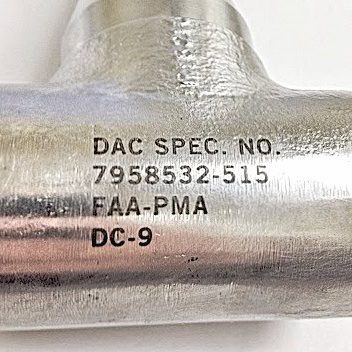
Universal Marking Inc. operates as a premier part marking facility for the aerospace, defense, medical, and industrial sectors. Since 1975, our team has executed precision electrochemical etching services and highly specialized, difficult material marking solutions that meet strict regulatory standards. Learn more about the specific mechanics of an electrochemical etch, the heavy industrial applications of electrolytic etching, and our extensive material capabilities below.
We serve manufacturers who need permanent, high-contrast marks on heat-treated and difficult-to-mark metals. Our process safely handles materials that challenge conventional marking methods- including hardened steel over 60 Rockwell, titanium alloys, and anodized aluminum- without ever inducing mechanical stress or compromising base material properties.
What is Electrochemical Etching?
Electrochemical etching, frequently referred to as electrolytic etching or chemical etching, utilizes an electrolyte-soaked electrode pressed against a custom stencil over a metal component. Electric current passes directly from the electrode through the stencil openings. This targeted current dissolves the metal substrate to create the desired mark. Operators control the exact depth via dwell time, where extended surface contact produces a deeper, permanent electrochemical etch.
The process operates entirely at room temperature and avoids the mechanical stresses associated with impact-based marking methods. Unlike impact stamping or extreme thermal processes, this method removes material through highly controlled dissolution. This localized chemical reaction leaves sharp, crisp edges while minimizing impact on the underlying material properties of the base metal.
Our facility utilizes two distinct current modes. DC produces a light, frosted appearance, whereas AC yields a darker, high-contrast mark. Both modes successfully execute shallow surface marks (less than 0.001�) or deep impressions up to 0.006�, depending entirely on your strict application requirements.
Benefits of Electrochemical Etching
Electrochemical etching provides a non-contact alternative to mechanical marking, making it ideal for sensitive or hardened components. By utilizing chemical dissolution rather than physical force, this method outperforms traditional mechanical processes in several critical areas, including:
- Zero mechanical stress. The material removal is chemical, not physical. Parts remain free of the microcracks, work hardening, and distortion that can result from impact stamping or vibro peening.
- Heat-treated material compatibility. The process easily marks through materials hardened to 60 Rockwell and beyond. No annealing, pre-softening, or post-treatment is required.
- Preserved material integrity. The process preserves the functional integrity of the base material, which is especially important in aerospace and medical applications with strict qualification requirements.
- Economical setup. Stencils are produced in-house from digital artwork. Per-unit costs remain economical even for short production runs or prototype batches.
- Absolute edge sharpness. Marks retain crisp, well-defined edges at depths up to 0.006�. There is no heat-affected zone and no material displacement at the mark boundary.
Applications of Electrochemical Etching
Our team has executed precise electrolytic etching across more than 25 demanding industries since 1975. Engineers actively specify this method for several high-stakes components:
- Aerospace components. Turbine blades, drive shafts, fluid pumps, generators, landing gear assemblies, and structural fasteners require permanent traceability marks per SAE AS478, Gulfstream GAMPS 1103, Aerojet Rocketdyne RA-1104-003 and MIL-STD-130 specifications.
- Defense and military hardware. We mark firearms, tactical aircraft parts, electronic assemblies, and missile components to strict government specifications, including Boeing BAC5307, Parker Aerospace BPS 4106, General Electric P23TF3, and Sikorsky SS8798.
- Medical devices. Surgical instruments, specialized syringes, titanium bone implants, and dental tools demand markings where biocompatibility and strict cleanliness remain non-negotiable.
- Industrial and automotive parts. Heavy vehicle components and specialized machinery elements rely on electrochemical etching for permanent identification. This method is critical for parts that cannot suffer stress concentration or dimensional changes that might compromise structural fatigue life.
We successfully mark both heat-treated and non-heat-treated metals, including stainless steel, bare aluminum, anodized aluminum, titanium, brass, and heavy carbide.
Our Electrochemical Etching Services
Universal Marking Inc. provides specialized etching services from our Paramount, California facility. To support high-stakes aerospace and defense contracts, we maintain strict AS9003 approval and operate in compliance with ITAR requirements.
Our facility executes comprehensive electrochemical etching services to meet exact client specifications:
- Precision depth control. We execute very shallow marks (<0.001�) or deep impressions (0.006�) based precisely on your engineering drawing.
- Custom mark appearance. We utilize specific DC and AC currents to create either light frosted marks or high-contrast dark marks.
- In-house stencil production. You submit your logo, text, or technical drawing directly to our team, and we manufacture the stencil internally to accelerate production.
- Extensive material compatibility. We mark stainless steel, aluminum, titanium, and advanced alloys regardless of their heat-treated status.
- Strict specification compliance. Our quality management system actively supports SAE AS478, MIL-STD-130, Boeing BAC5307, Parker Aerospace BPS 4106, General Electric P23TF3, Gulfstream GAMPS 1103, Aerojet Rocketdyne RA-1104-003, and Sikorsky SS8798 standards.
Custom Electrochemical Etching from Universal Marking
Finding reliable, difficult material marking solutions for hardened alloys and sensitive components requires a highly specialized manufacturing partner. A proper electrochemical etch permanently identifies your parts without inducing mechanical stress or altering base material properties. If your procurement team requires exact electrolytic etching backed by AS9003 quality controls, Universal Marking possesses the precise equipment and deep experience to execute the job.
Contact our team today to discuss your exact electrochemical etching application, or request a quote to securely submit your drawings and initiate your next production run.