Part identification is a non-negotiable requirement across aerospace, military, medical, and industrial manufacturing. Components must carry legible, durable, and specification-compliant marks from production through final inspection.
Universal Marking, Inc. (UMI) has provided industrial ink marking services across these critical sectors since 1975, operating as a centralized source for contract part marking from our facility in Paramount, CA.
What Is Ink Marking?
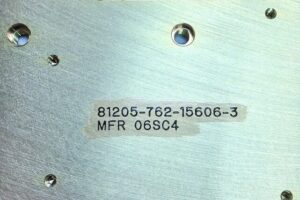
Ink marking applies a custom image, code, or identifier directly to a part surface using a rubber stamp or stencil. A clear polyurethane topcoat can then be applied to protect the mark and maintain legibility of part numbers, serial codes, and cage codes throughout the component’s service life.
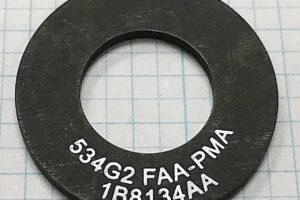
Industrial ink marking works across metals, plastics, composites, and coated surfaces without cutting into the material or altering part geometry. When a job calls for permanent ink for metal components, industrial ink marking systems deliver consistent, specification-compliant results across high-volume production runs.
Benefits of Ink Marking
Ink marking applies minimal pressure and leaves no indentation or mechanical stress on the substrate. This makes it well-suited for finished aerospace and medical parts.
These processes provide highly visible identification that withstands rigorous operational environments. Key advantages include:
- Long-lasting marks. High-contrast ink ensures clear readability under inspection lighting, barcode scanners, and UV sources on both flat and curved surfaces.
- Low-pressure application. The stamping process causes no surface deformation, making it suitable for sensitive or fully finished components.
- High-contrast output. Marks remain legible on metals, plastics, composites, and coated surfaces throughout the part’s service life.
Ink Marking Applications
Industrial ink marking suits any industry requiring traceable, low-stress part identification. From primary component tracking on airframes to identification marks on industrial equipment, primary applications include:
- Aerospace. Part serialization on turbine blades, structural fasteners, and control panels to meet ITAR and AS9003 traceability requirements.
- Military & defense. Marking firearms components, electronic assemblies, IUID codes, and vehicle parts to MIL-STD-130 and related defense specifications.
- Medical. Identifying surgical instruments and implant components without affecting surface finish or biocompatibility coatings.
- Industrial & automotive. Stamping part numbers, date codes, and batch identifiers on components across high-volume assembly lines.
- Promotional & retail. Custom logos, serial numbers, and decorative marks on awards, merchandise, and branded products.
Our Ink Marking Services
We manufacture custom rubber stamps in-house, keeping tooling costs low and lead times short. Our industrial ink marking systems are built around deep working knowledge of inks specified across aerospace, military, and industrial standards. Key capabilities include:
- In-house stamp manufacturing. Custom-made rubber stamps produced on-site, reducing customer costs and turnaround time.
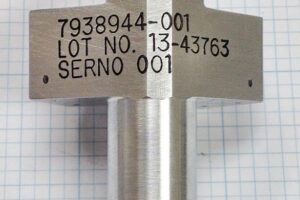
- Serialization capability. Part numbers, manufacturing numbers, IUID codes and cage codes are marked with consistent character placement across every piece in a run.
- Specification-compliant inks. MIL-STD-130, Boeing Spec BAC5307, Parker Aerospace Spec BPS 4106, General Electric Spec P23TF3, and Sikorsky Spec SS8798.
- Two-part epoxy inks. Greatly reduced drying times compared to single-component formulas, supporting high-volume production schedules.
- Clear polyurethane topcoat. Applied over the ink mark to improve durability and extend mark life.
Types of Ink Marking Processes
We use six distinct industrial ink marking methodologies, matching each process to specific part geometries, substrate tolerances, and production volumes:
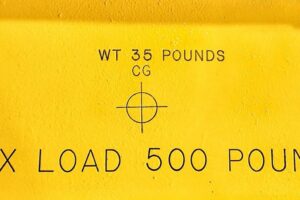
- Ink marking/rubber stamping. A custom rubber stamp applies a uniform mark without deforming the surface. A polyurethane topcoat helps protect the mark from fluids and handling.
- Ink rolling. An inked stamp rolls across a cylindrical surface in a single continuous motion, producing clean, legible marks on shafts, tubes, and similar geometries.
- Ink filling. The part is first engraved or etched, then filled with ink. The recessed mark provides greater abrasion resistance than surface-applied markings.
- Pad printing. A silicone pad transfers an image onto contoured and irregular surfaces that flat stamps cannot mark effectively.
- Stencil marking. Ink or paint passes through a stencil opening onto the substrate, scaling well to large surface areas and non-standard shapes.
- Silk screening. Ink is pressed through a stenciled graphic on a mesh fabric using a rubber blade, transferring the image onto the substrate. This process suits fabric, glass, metal, plastic, and wood, and supports multi-color output through layered screens.
Partner with UMI for Specification-Compliant Industrial Ink Marking
Since 1975, Universal Marking has provided industrial part-marking solutions ranging from simple rubber stamps to fully serialized marking programs for metal components. With AS9003 approval and ITAR compliance, we serve as a single source for a wide range of part marking requirements.
Contact us to discuss your project or request a quote, and a sales professional will respond promptly.